Replica Method for the Sherrington-Kirkpatrick Model
This note reviews the replica symmetric solution of the SK model, including sufficiently detailed derivations, and then shows the phase diagrams of the order parameters and free energy by numerical calculations. The author acknowledges H. Nishimori’s book 1 for its introduction to the mean-field theory of spin glass, and Haozhe Shan’s notes 2, which contain extensive derivations and greatly assisted the author in following the derivation.
1. Introduction
The Hamiltonian of the Sherrington-Kirkpatrick model reads
where
The mean and variance are both proportional to
However, it is only the free energy for a fixed interaction
The dependence of
2. Replica Method
The replica trick is a mathematical technique based on the application of the formula
In this case, the replica average of the partition function can be written as
where the explicit expression of the integral measure
Firstly, Eq. (4) can be calculated as
where the integral term in Eq. (6) is calculated as
and the following trick is used in Eq. (8)
Considering
we have
and
Thus Eq. (10) is written as
where the following approximation in the large
In order to linearize the quadratic term on the exponential, it is useful to introduce the Hubbard-Stratonovich transform, an inverse application of the Gaussian integral, as follow
Let
Let
Then Eq. (19) can be written as
where we define
in Eq. (25) and used
In large
Let
and the result of the integral is
where we used Taylor expansion in Eq. (33), and
The free energy density
3. Replica Symmetry Ansatz
To continue solving Eq. (36), we need to consider the dependencies of
where
The final item is calculated as
where we used Hubbard-Stratonovich transform again in Eq. (40) and reparameterized
The last item in Eq. (41) is calculated as
where we defined
Finally, the replica symmetric free energy is
Through
we obtain a set of closed equations, called saddle point equations
4. Numerical Results
Considering a simple case where
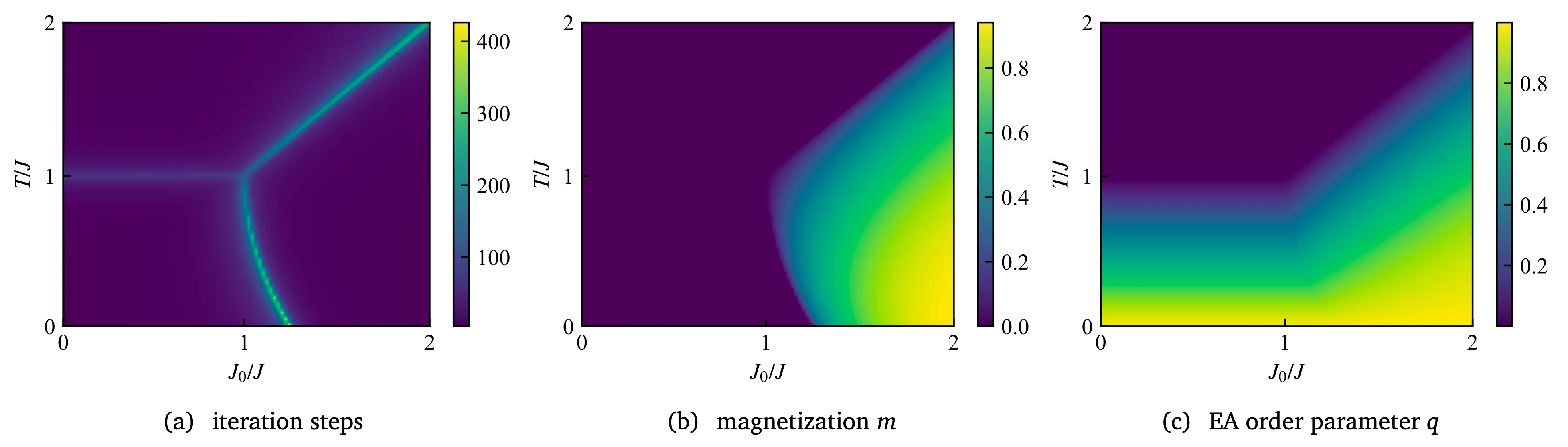
This results (especially the interaction steps) recover the well-known phase diagram of the SK model with three phases: ferromagnetic phase, paramagnetic phase, and spin glass phase.
Due to the Frustration, the spin in the SK model is frozen at low temperature, yet remains highly disordered, with the order parameter
Footnotes
-
H. Nishimori, Statistical Physics of Spin Glasses and Information Processing: An Introduction (Oxford, 2001) ↩
-
Replica calculations for the SK model, URL: hzshan.github.io/replica_method_in_SK_model.pdf ↩